Everything You Need to Launch Your Second Act Business. Nothing You Don't.
The Housekeeping SOP Format That Keeps Your Cleaning Business Running Smoothly
The Housekeeping SOP Format That Keeps Your Cleaning Business Running Smoothly - A practical, experience-backed walkthrough of the housekeeping SOP format cleaning business owners need to create consistency, train employees confidently, and build a business...
TEMPLATES
3/20/20265 min read
When Michelle and I started our cleaning business seven years ago, I thought I could keep everything in my head. The right way to clean a bathroom. The order to tackle rooms. What to do when a client had a dog or a houseplant jungle blocking the windows.
That worked fine when it was just the two of us.
The minute we brought on help, that system collapsed overnight.
A housekeeping SOP format—a Standard Operating Procedure—is what keeps a cleaning business from depending entirely on you being there. After 7 years running our Michigan operation, I can tell you that getting this right is the difference between a business that runs and a business that runs you ragged.
This isn't glamorous stuff. But it works, and I'm going to show you exactly how to build it.
Why Most Cleaning Business Owners Skip This (And Pay for It Later)
Here's what I see constantly with new cleaning business owners, especially those of us starting over after 45: we assume that because we know how to clean well, that knowledge will somehow transfer to the people we hire.
It doesn't.
I learned this the hard way. We hired our first team member and sent her to a repeat client's home. She did a perfectly competent job—by her standards. But the client called me that evening because the ceiling fans hadn't been touched and the baseboards were skipped entirely. Those were things we always did. We just never wrote it down.
That client put us on thin ice for two months before trust was rebuilt.
The problem isn't bad employees. The problem is that you handed someone a job with no clear definition of what "done" looks like. Without a documented format, every cleaner improvises—and clients notice inconsistency even when they can't name it. They just stop calling.
If you're building a cleaning business to eventually step back, travel, or yes—escape Michigan winters like I'm working toward—you cannot build location independence on a business that only runs correctly when you're standing in the room.
The Housekeeping SOP Format That Actually Works
A good SOP doesn't need to be a 40-page manual. Ours fit on two laminated pages per property type for years. Here's the format we use, broken into four core sections.
Section 1: Property Profile
Before a cleaner touches a mop, they need to know what they're walking into. This section covers:
Property type (residential, Airbnb, commercial)
Square footage and number of rooms
Client preferences and pet/allergy notes
Access instructions (key code, lockbox, garage entry)
Special instructions (don't move the antique clock, use only the client's products, etc.)
Pro tip: Keep a one-page "Client Profile Sheet" clipped to the job folder. It saves five minutes of confusion and one awkward phone call per job.
Section 2: Room-by-Room Task List
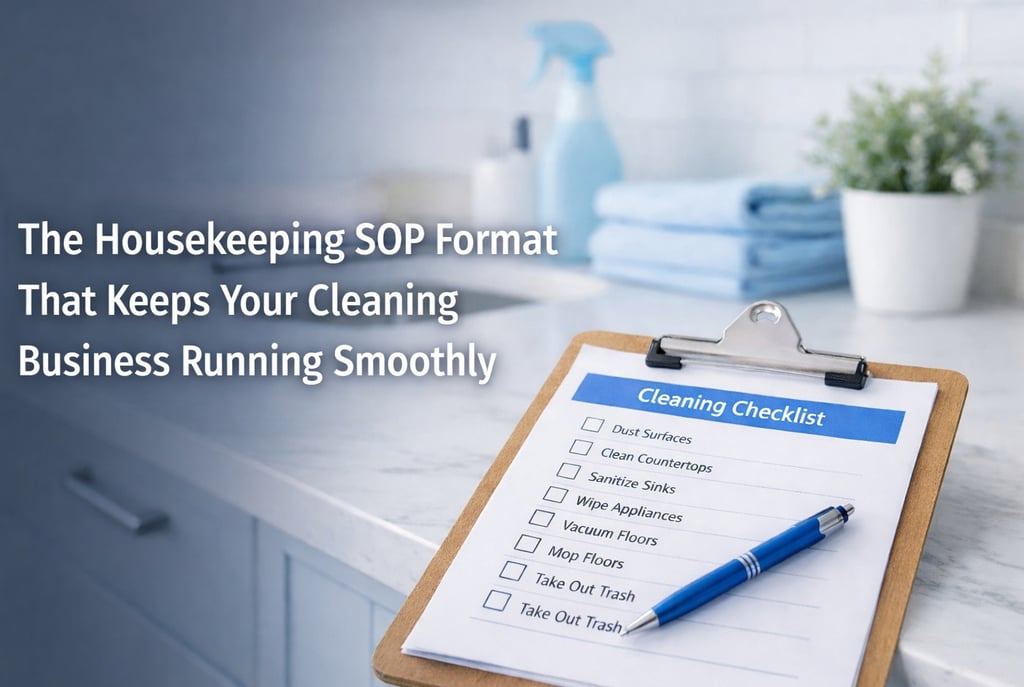
This is the core of your housekeeping SOP format. Each room gets its own section with tasks listed in a logical sequence—not alphabetically, not randomly, but in the order a cleaner should physically move through the space.
Example for a standard bathroom:
Spray and let cleaner dwell on toilet, tub, and sink
Wipe mirrors and glass surfaces
Scrub toilet (lid, seat, bowl, base)
Scrub tub/shower
Scrub and rinse sink
Wipe countertops and fixtures
Clean exterior of cabinets
Empty trash
Sweep/vacuum floor
Mop floor
Replace towels per client preference
Final visual check
Notice that the cleaner lets products dwell while doing other tasks—that's a real efficiency move that new hires won't figure out on their own unless you put it in the SOP.
Section 3: Quality Control Checklist
At the end of each job, your cleaner (or you, during inspections) runs through a final check. This section answers the question: How do we know it's actually done right?
Keep this short—no more than 10-15 items per property type. Things like:
All surfaces wiped and streak-free
Floors cleaned, no visible debris in corners
Trash emptied and bags replaced
No products or tools left behind
Entry points locked and secured
This checklist is also your best friend when a client calls with a complaint. You either have a signed-off sheet that shows the job was completed correctly, or you have a training opportunity.
Section 4: Notes and Client Communication Log
The last section is simple: a space to log anything unusual from that visit.
Client's water heater was making noise. Back bedroom was skipped per client request. Dog was in the house—kept bathroom door closed. Small scratch noted on the hallway baseboard (pre-existing).
This protects you. It also builds trust with clients over time because you can reference their history and preferences.
💡 Free Resource: Grab my Complete Cleaning Business Startup Guide—it includes worksheets, pricing calculators, client scripts, and templates covering everything from your first client to your first hire. No fluff, just the stuff I wish I'd had when I started at 51.
How to Actually Implement This Without Overwhelming Yourself
You don't need to build all of this in a weekend. Here's how I'd sequence it if I were starting over:
Week 1: Create the room-by-room task list for your most common property type. Just one. Write down exactly what you do, in order. That's your first SOP.
Week 2: Build the quality control checklist. Walk through your next three jobs with it and adjust anything that feels off.
Week 3: Add the property profile section and start using it for every new client onboarding.
Week 4: Create the communication log template and attach it to your job folders.
The most common concern I hear from 45+ entrepreneurs is "I don't have time for all this paperwork." I understand that completely. But here's the reality: you're going to spend that time either building the system once, or answering the same questions and fixing the same mistakes indefinitely. The SOP is the shortcut, not the detour.
Start with one document. One room type. One checklist. Build from there.
What Separates Professionals from People Who Just Clean Houses
After seven years, here are the mistakes I see most often—and what the pros do differently.
Mistake #1: Making the SOP too vague. "Clean the kitchen" is not an SOP. "Wipe all cabinet fronts, clean stovetop burners, degrease range hood, clean inside microwave, scrub sink" is an SOP.
Mistake #2: Creating it once and never updating it. Your SOP should evolve. When a client complains about something, that complaint usually points to a gap in your document. Fix the SOP, not just the situation.
Mistake #3: Not training to the SOP. A written document means nothing if your team never walks through it with you on an actual job. Do one shadow session per new hire, SOP in hand.
As a second-act entrepreneur, you've managed projects, trained people, or run departments before. You already understand that systems scale and individuals don't. Apply that same logic here.
If you want the exact SOP templates, quality control checklists, and operations documents Michelle and I use in our own business, they're all included in my Complete Bundle ($347)—built and refined over seven years of real-world use.
Building Something That Runs Without You
The whole reason I'm building systems like this—and teaching others to do the same—is that I want the option to step away someday. Not permanently. Just enough to spend a Michigan winter somewhere warmer.
That only happens if the business works when I'm not in it. And that only happens if every job is documented well enough that a competent person can follow it without me on the phone.
Your housekeeping SOP format is step one of that freedom. It's not exciting work, but it's the work that matters.
Start simple. Write down what you do. Make it repeatable. Refine it as you go.
Seven years of doing this the right way has given me a business I'm proud of—and the momentum to build toward something even better. You can do the same thing.
📋 Ready to Build Your Cleaning Business the Right Way?
Download my free Complete Cleaning Business Startup Guide—worksheets, pricing calculators, client scripts, and templates all in one place. Everything I wish I'd had when Michelle and I started at 51.
No hype. No fluff. Just practical steps from someone who's actually done it.
© 2026 Second Act Systems. All rights reserved.