Everything You Need to Launch Your Second Act Business. Nothing You Don't.
SOP Format for Housekeeping: The System That Keeps My Cleaning Business Running Smoothly
A practical guide to building a simple, effective SOP format for housekeeping—written by a 7-year cleaning business owner for entrepreneurs who want consistency without the corporate complexity.
TEMPLATES
4/10/20265 min read
When Michelle and I first started our cleaning business at 51, I thought experienced cleaners would just... know what to do. I figured good work speaks for itself and everyone has their own method. That assumption cost us clients.
The fix was simpler than I expected: a proper SOP format for housekeeping that anyone on the team could follow, every single time. After 7 years of running this business together, our SOPs are one of the things I'm most proud of building. They're not glamorous. But they work.
Here's what I've learned about creating them—and how you can build yours without overcomplicating it.
Why Most Cleaning Business Owners Skip This (And Regret It)
I get it. When you're starting out, you're busy doing the actual cleaning, landing clients, and figuring out pricing. Writing procedures feels like homework.
But here's what happens when you skip it:
Every job gets done slightly differently
A new hire has no clear standard to follow
Client complaints come out of nowhere
You end up fixing every problem personally
We learned this lesson when we were scaling up and brought on help for the first time. Without written procedures, we were essentially hoping everyone cleaned the same way we did. They didn't.
The hardest version of this lesson? When we lost a $2,400/month commercial contract because a team member missed steps we'd never written down. That's the kind of thing that gets your attention fast.
Writing SOPs after the fact felt like closing the barn door after the horse left—but those procedures protected every client relationship we had after that.
What a Good SOP Format for Housekeeping Actually Looks Like
Forget the fancy operations manuals you might picture from corporate life. A good housekeeping SOP is clear, simple, and written for the person doing the job—not for you.
Here's the format that works for us:
1. The Header Block
Every SOP starts with basic information so there's never any confusion about what you're looking at:
Procedure Name (e.g., "Standard Residential Deep Clean")
Applies To (e.g., all residential clients, or a specific property type)
Frequency (one-time, recurring weekly, monthly, etc.)
Estimated Time (this helps with scheduling and quoting)
Last Updated (yes, SOPs need updating—more on that later)
2. Supplies & Equipment Checklist
Before anyone walks through a client's door, they should know exactly what they need. List every product, tool, and supply required for the job. We format ours as a simple checklist our team can verify before they leave.
Pro tip: We color-code supplies by room—green for bathrooms, blue for kitchens. Sounds minor, but it eliminates cross-contamination complaints.
3. Step-by-Step Room Procedures
This is the heart of your SOP. Break each room into a sequence of steps written in plain language. Think of it as instructions for someone brand new to the job.
Kitchen example:
Clear and wipe all countertops
Clean stovetop and range hood
Wipe exterior of appliances (microwave, fridge, dishwasher)
Scrub sink and faucet
Clean inside microwave
Mop floor last (always last)
Notice the logic? High to low, perimeter to center, dry tasks before wet. That's not arbitrary—it's efficiency built into the sequence.
4. Quality Check Points
At the end of each room, include 3-5 items to verify before moving on. These are your non-negotiables—the things clients will absolutely notice.
For bathrooms: mirrors streak-free, toilet base clean, fresh towels aligned, no soap scum visible on glass.
5. Client-Specific Notes Section
Every client has quirks. One wants you to avoid a certain cleaner near her marble counters. Another has a dog who needs to be kept in a specific room. This section lives at the top of any job-specific SOP addendum so nothing gets missed.
💡 Free Resource: Grab my Complete Cleaning Business Startup Guide—it includes the worksheets, checklists, and templates I wish I'd had when I started at 51. No fluff, just what works.
How to Actually Build These (Without Spending a Week on It)
The biggest mistake people make is trying to write the perfect SOP before they even start. Don't.
Here's my practical approach:
Week 1: Pick your most common service—probably a standard residential clean—and write that SOP only. Do the job, write the steps as you go. Rough is fine.
Week 2: Have someone else follow it and note where they get confused. Those gaps are your revisions.
Week 3: Formalize it. Add the header block, supplies list, and quality checks. One clean document.
Then repeat for your next service type.
You don't need 20 SOPs on day one. You need one good one and a habit of building more as you grow.
One concern I hear from second-act entrepreneurs: "I've never written procedures before." Here's the thing—you've probably been following procedures your entire career. You know what good work looks like. Writing it down is just capturing what you already know.
Advanced Tips From 7 Years of Running This System
Keep them short. If a single SOP is more than two pages, it won't get used. Cut it down.
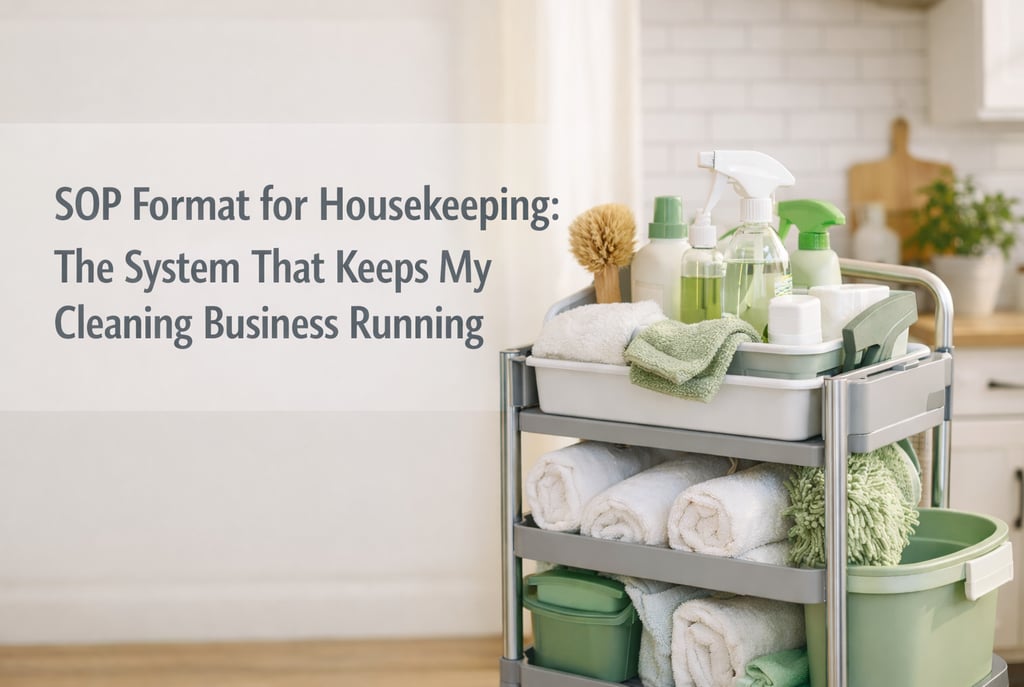
Use photos. A picture of how the towels should be folded or how the cleaning cart should be organized is worth 100 words of description.
Review annually at minimum. Products change, client expectations shift, and your standards should improve over time. An outdated SOP is almost as bad as no SOP.
Involve your team. The people doing the work often know the most efficient sequence. When Michelle and I asked our team for input, we actually improved our procedures—and they were more likely to follow steps they helped create.
Don't confuse SOP with training. The SOP is the standard. Training is how you teach it. They work together, but they're not the same thing.
The difference between a cleaning business and a cleaning hobby is whether it runs consistently without you making every decision. That's what SOPs actually buy you.
If you want the complete SOP templates Michelle and I use in our own business—already formatted and ready to customize—they're included in my Complete Bundle along with everything else we've built over 7 years.
See All That Is Included In The Bundle Here
Building Something That Lasts
Here's what I know after seven years: the businesses that survive aren't necessarily the ones with the fanciest equipment or the most aggressive pricing. They're the ones that deliver consistent results, every time.
A solid SOP format for housekeeping is how you get there. It protects your reputation, makes training easier, and—honestly—gives you breathing room. When your team knows exactly what to do, you don't have to be everywhere at once.
That matters a lot to me. My goal is eventually to run this business from somewhere warm while Michigan is buried in snow. That only happens if the systems are solid enough to run without me standing over every job.
Start with one procedure. Build from there. You've got more than enough experience to do this well.
📋 Ready to Build Your Cleaning Business Right?
Download my free Complete Cleaning Business Startup Guide—worksheets, pricing calculators, client scripts, and templates. Everything I wish I'd had when I started at 51.
No hype. No fluff. Just practical tools from someone who's been doing this for 7 years.
© 2026 Second Act Systems. All rights reserved.