Everything You Need to Launch Your Second Act Business. Nothing You Don't.
How to Start a Cleaning Business: A No-Fluff Beginner's Guide
A no-fluff, experience-based guide for beginners who want to start a cleaning business — covering licensing, equipment, pricing, getting first clients, and the simple systems that keep it running.
STARTING/MARKETING
4/28/20265 min read
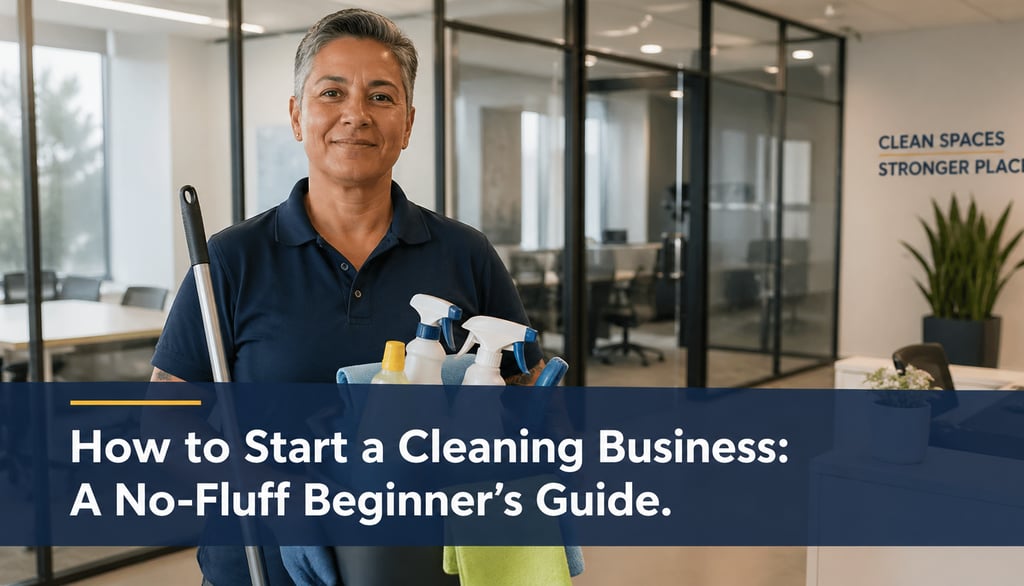
Want to start a cleaning business but don't know where to begin? Here's the practical, no-hype guide from someone who's run one for 7 years — covering licensing, pricing, clients, and everything in between.
Let me be straight with you: starting a cleaning business is not complicated. It's not easy, but it's not complicated. There's a difference.
When I started our cleaning business with my wife Michelle at 51 years old, I spent weeks reading articles that made it sound like I needed a business degree, a marketing team, and some magic formula to get clients. None of that turned out to be true. Seven years later, we're still running it — and we built it from zero without any of that noise.
If you're trying to figure out how to start a cleaning business and you're tired of articles that are heavy on motivation and light on actual information, you're in the right place. This is everything I wish someone had handed me on day one.
Step 1: Decide What Type of Cleaning Business You Want
This decision shapes everything — your equipment, your pricing, your schedule, and who you're selling to. The three main paths are:
Residential — Houses, apartments, condos. Flexible hours, but often lower margins and high client turnover.
Commercial — Offices, retail, medical. Usually after-hours work, steadier recurring contracts, and higher revenue per client.
Specialty — Post-construction, move-out cleans, Airbnb turnovers. Higher pay per job, but less predictable volume.
Michelle and I run primarily commercial, and it's been the right fit for us. Fewer clients, longer contracts, more predictable income. But residential is a legitimate path too — especially if you're starting solo and want daytime hours.
Pick one lane to start. Don't try to be everything to everyone on day one.
Step 2: Handle the Legal Basics (It's Simpler Than You Think)
You don't need a lawyer and you don't need to overthink this. Here's what most solo or small operations actually need to get started:
Business name — Pick something professional. Register it as a DBA (Doing Business As) with your county clerk if you're not forming an LLC.
LLC (optional but recommended) — Costs $50–$150 in most states. Separates your personal assets from business liability. Worth it.
EIN — Free from IRS.gov. Takes 10 minutes. You'll need it for taxes and opening a business bank account.
Business bank account — Non-negotiable. Keep business money separate from day one.
General liability insurance — This is not optional. $500,000 minimum coverage. Most clients will ask for it before they hire you. Budget around $50–$80/month to start.
That's your baseline. Some clients (especially commercial) will also want to see a certificate of insurance before signing anything. Get used to having that ready to send.
Step 3: Get Your Equipment Together Without Overdoing It
This is where a lot of beginners blow money they don't need to spend. You do not need a fully stocked van on day one.
For a basic residential start, you need:
Vacuum (commercial-grade upright — Shark or Bissell pros work fine to start)
Mop and bucket
Microfiber cloths (buy in bulk — they're cheap and they matter)
All-purpose cleaner, glass cleaner, bathroom disinfectant, degreaser
Caddy to carry it all
For commercial, add a flat mop system and a backpack or canister vacuum. That's it.
Pro tip: Some clients will ask you to use their products. That's actually great — it's less you have to carry.
Total startup equipment cost for a solo operation? You can legitimately get started for under $300. Don't let anyone tell you otherwise.
Step 4: Price Your Services to Make Money
Underpricing is the single most common mistake new cleaning businesses make — and it's a trap that's hard to climb out of. When you price too low, you attract price-sensitive clients who are never satisfied, and you're locked into a rate that doesn't cover your time.
Here's a simple framework:
Hourly rate starting point: Figure out what you need to earn per hour after expenses (supplies, insurance, fuel, taxes) and add a profit margin on top of that. For most markets, residential solo cleaning runs $35–$55/hour. Commercial can run $45–$75/hour depending on the scope.
Flat rate pricing (residential): Most clients prefer a flat rate over hourly — it removes the uncertainty for them. Charge what the job is actually worth based on your time estimate. A standard 3-bedroom house might run $120–$180 for a recurring clean.
Commercial pricing: Figure square footage, frequency, and task list. Price per square foot typically runs $0.08–$0.18 depending on the type of facility and what's included.
💡 Free Resource: Not sure where to start with pricing, contracts, and client systems? Download my free [Cleaning Business Startup Guide] at SecondActSystems.com — no fluff, just the practical tools Michelle and I use in our own business.
Step 5: Get Your First Clients
Here's what actually works when you're starting out:
Tell everyone you know. Seriously. Your first 2–3 clients are almost always word-of-mouth. Don't overthink this. Text people, post on your personal Facebook, send emails. Be direct about what you're doing.
Google Business Profile. Set one up for free. Add photos, your service area, and your services. This is how people find local cleaners when they search. It's one of the highest-ROI free marketing moves you can make.
Nextdoor and neighborhood Facebook groups. These are gold for residential cleaning leads. Post an introduction, offer a first-clean discount, and respond fast when people comment.
For commercial: Walk in and ask. Sounds old-fashioned, but it still works. Small offices, real estate agencies, medical practices — introduce yourself, bring a business card, and ask who handles their cleaning. You'll get a "no" most of the time. You only need a few yeses.
Step 6: Set Up a Simple Client System From Day One
You do not need fancy software to start. But you do need some kind of system — even a basic one — because winging it will eventually catch up with you.
At minimum, have:
A client info sheet (address, key access, special notes, pet info, billing)
A service agreement that both parties sign before you start
A simple invoice process — even a free tool like Wave or an invoice template works fine
A cleaning checklist for each job type so nothing gets skipped
When we lost a commercial contract in our early years, it was partly because we didn't have written procedures. The client had no confidence we'd be consistent without us being there. Systems give clients confidence. They also protect you.
If you want the actual contracts and client documents I use in my business, they're in the Essential Templates Pack at SecondActSystems.com — the same ones we've used for years.
Common Mistakes to Avoid
Seven years in, here's what I've watched trip people up repeatedly:
Taking any client at any price — Some clients cost you more in stress than they pay you. Learn to qualify early.
Not having a contract — "We had a verbal agreement" doesn't hold up when someone refuses to pay.
Skipping insurance — One accident in someone's home without coverage can end the business and then some.
Underestimating a job and absorbing the loss — Estimate carefully. Build in buffer. Protect your time.
Waiting until everything is "ready" — There's no perfect moment. Get your legal basics in place, get insured, and go find a client.
The Bottom Line
Starting a cleaning business doesn't require a big investment, a fancy website, or years of industry experience. What it requires is a willingness to do the work, some basic systems, and the sense to price yourself fairly.
Michelle and I started at 51 with almost nothing but the knowledge of how to clean a building well. Seven years later, it funds our life while I build additional income streams around it.
If we can do it, you can do it.
📋 Ready to Get Started? Grab my free [Cleaning Business Startup Checklist] at SecondActSystems.com — complete with pricing worksheets, a first-client script, and the steps we used to launch. No hype, no fluff. Just the practical stuff.
© 2026 Second Act Systems. All rights reserved.