Everything You Need to Launch Your Second Act Business. Nothing You Don't.
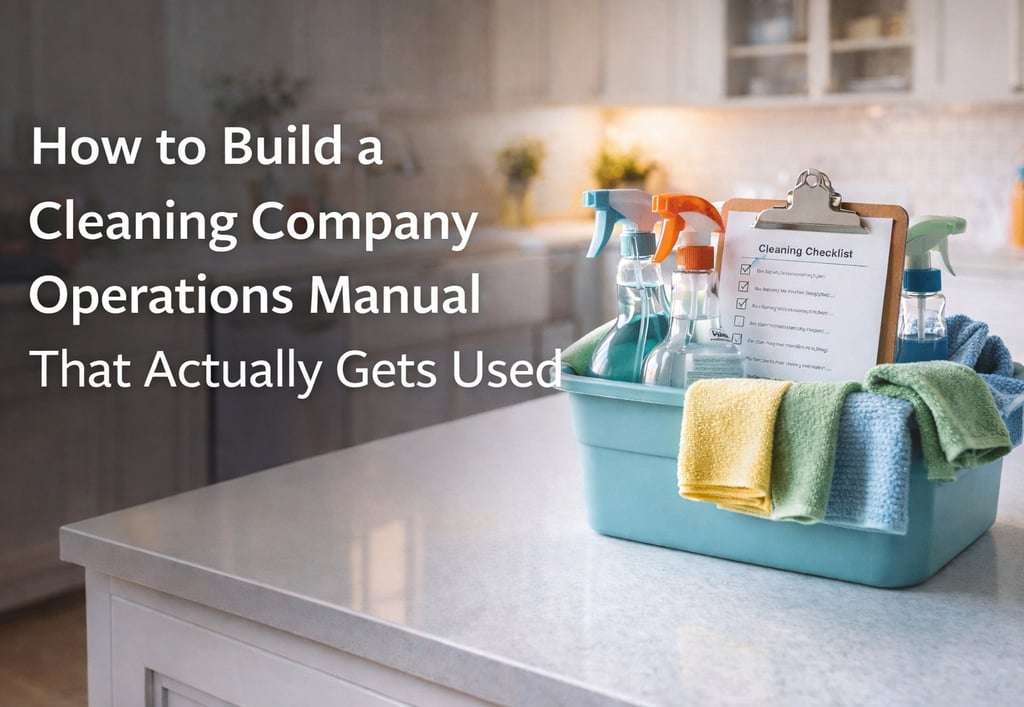
How to Build a Cleaning Company Operations Manual That Actually Gets Used
A practical guide for cleaning business owners who want to get their systems out of their heads and onto paper—covering the seven key sections of a cleaning company operations manual, with a realistic 30-day build plan.
TEMPLATES
2/3/20266 min read
The Day I Realized I Was the Operations Manual
A few years into running our cleaning business, Michelle and I had a solid client base going. Things were humming. Then I took a few days off to deal with a family situation, and she had to handle a new client onboarding completely on her own.
It went fine—because she already knew everything by heart. But it made us both realize something: what happens when we eventually bring on help? Everything we knew lived in our heads, not on paper.
That's the trap most cleaning business owners fall into. You build a system through trial and error, it lives in your memory, and the whole operation depends on you being there.
A cleaning company operations manual changes that. It takes everything you know—your cleaning procedures, your pricing, your client communication, your quality standards—and puts it somewhere that doesn't forget, doesn't get sick, and doesn't depend on one person.
After 7 years running this business with my wife Michelle, I want to walk you through exactly how to build one—practically, without overcomplicating it.
Why Most Cleaning Businesses Never Document Anything
Here's the thing: people who start cleaning businesses at 45 or 50 aren't lazy. You've worked hard your whole career. You know how to get things done.
But documentation feels like corporate busy-work. Like something big companies do, not solo operators with a few clients and a van full of supplies.
So you skip it. And everything works fine—until it doesn't.
Here's where the lack of an operations manual actually hurts you:
A new team member does a job differently than you would, and a client notices
You price a job by feel, then realize later you undercharged
A client dispute comes up and you have no documented procedure to point to
You want to step back from operations—even for a week—but you can't because everything depends on you
When we lost our biggest client—a $2,400/month commercial account—one of the contributing factors was inconsistency. Different people on the crew were doing the same tasks in different ways, and over time the client noticed the variation. We had the knowledge in our heads but not on paper in any form that could guide a team.
That experience lit a fire under me to get serious about documentation.
What to Put in Your Cleaning Company Operations Manual
Here's the good news: you don't need to write a 60-page document. A working operations manual for a small cleaning business can be 10–15 pages and still cover everything that matters. Start lean, build as you go.
Section 1: Your Business Overview
This is the one page that orients anyone who works with you or for you. Include:
What services you offer (residential, commercial, move-in/out, post-construction, etc.)
Your service area
Your core values and how you want clients treated
Who does what (even if it's just you and your spouse)
Pro tip: Write this like you're explaining your business to a new hire on day one. That's essentially what it's for.
Section 2: Cleaning Procedures and SOPs
This is the heart of your manual—and the most time-intensive part to write. Standard Operating Procedures (SOPs) sound fancy, but they're really just checklists with a bit more context.
For each service type you offer, document:
Room-by-room cleaning sequence (order matters for efficiency)
Products used and which surfaces they're appropriate for
Equipment and supplies per job type
Time estimates for each area
Common mistakes to avoid
For example, our kitchen SOP specifies: wipe down cabinet fronts before the floor, because crumbs fall. Simple thing. Took me two years of doing it the wrong way before it became muscle memory—and would have taken a new team member the same amount of time to figure out without guidance.
Section 3: Pricing Framework
Your pricing lives in your head right now. Get it out. Document:
Your minimum job price (we never go below a certain threshold—not worth the drive)
How you calculate pricing for residential vs. commercial
Add-on pricing (deep cleans, fridge cleaning, laundry, etc.)
When and how you raise rates
This becomes invaluable when you're quoting a job quickly, or when you eventually want someone else to handle estimates.
Section 4: Client Communication Standards
How you communicate is part of your brand. Document:
Response time expectations (we commit to responding within a few hours)
What you say when confirming an appointment
How to handle complaints (and there will be complaints)
Follow-up procedures after a first clean
Pro tip: Write out scripts for the conversations you have over and over again. What do you say when a client asks you to lower your price? When they want to add a service mid-job? Having a script ready means you handle it consistently every time—not however you feel that day.
Section 5: Quality Control
This section answers: "How do we know we did a good job?"
Include:
Your inspection checklist (room by room)
What to do if something doesn't meet standard before you leave
How you handle a client complaint about quality
Your re-clean policy
Section 6: Equipment, Supplies & Inventory
This one gets overlooked constantly. Document:
What products you use and why
Where you buy supplies and roughly what you pay
Minimum stock levels before you reorder
Equipment maintenance schedule (vacuums don't last forever)
Section 7: Emergency Protocols
What happens when something goes wrong? Document:
What to do if something gets damaged during a job
Who to call
How to document and report an incident
Your insurance information
[CTA #1 HERE]
💡 Free Resource: Grab my free Cleaning Business Startup Checklist — it includes pricing calculators, client scripts, and checklists that pair perfectly with building your operations manual. No fluff, just the practical tools I wish I'd had when I started at 51.
How to Actually Build This (Without It Taking Forever)
Here's the part nobody tells you: don't try to write your entire operations manual in a weekend. You'll burn out halfway through and never finish it.
Instead, build it in layers over 30 days:
Week 1 — Start with what's already working. Pick your most common service type and document just that cleaning SOP. Get the sequence out of your head and onto paper.
Week 2 — Add your pricing logic. Even a basic one-pager documenting your pricing approach is better than nothing.
Week 3 — Client communication and quality control. Write out your response scripts and your inspection checklist.
Week 4 — Fill in the rest. Supplies, emergency protocols, business overview.
After four weeks, you have a real, working operations manual. Not perfect—but functional.
Common concern: "I'm a solo operator. Why do I need this if it's just me?"
Because it won't always be just you. And even if it is, there's real value in being able to run your business from anywhere—including, say, somewhere south of Michigan during February.
Pro tip: Store your manual in Google Drive, not on your computer. That way you can access it anywhere, share it with a team member, and update it without hunting down the right file.
What Separates Professionals From the Rest
After seven years, here's what I've noticed about the cleaning business owners who build something sustainable versus those who stay stuck in the grind:
The professionals have their knowledge written down. Everyone else carries it in their head.
That's not an exaggeration. The owners who can step back, take a vacation, or eventually sell their business are the ones with documented systems. The ones working 60-hour weeks with no end in sight are usually running everything from memory.
A few other things that separate experienced operators from beginners:
Beginners improvise client complaints. Professionals have a documented process.
Beginners price by gut. Professionals follow a documented formula.
Beginners train by showing. Professionals have written SOPs that do some of the training for them.
As a second-act entrepreneur, you've probably managed systems, processes, or teams before in your previous career. This isn't foreign territory—it's just applying what you already know to your own business.
If you want the actual templates, SOPs, and pricing frameworks already built out—the ones Michelle and I use in our business—they're all included in my Complete Bundle. Less blank-page staring, more getting it done.
Your Operations Manual Is Your Business, on Paper
Here's the bottom line: a cleaning company operations manual isn't about bureaucracy. It's about building something that works without you—or at least, without all of you, all the time.
It's the difference between owning a business and just having a job you created for yourself.
Start with one section this week. The cleaning SOP for your most common service. Get that out of your head and into a document. Then build from there.
Seven years in, ours has saved us from more headaches than I can count. Yours will too.
📋 Ready to Get Started?
Download my free Cleaning Business Startup Checklist — pricing calculators, client scripts, templates, and a step-by-step launch guide. Everything I wish I'd had when Michelle and I started from scratch at 51.
© 2026 Second Act Systems. All rights reserved.