Everything You Need to Launch Your Second Act Business. Nothing You Don't.
How to Build a Cleaning Business Operations Manual That Actually Works
A practical guide to creating a cleaning business operations manual that actually gets used, written by a 7-year veteran who built systems to run his business without constant oversight.
STARTING/MARKETING
2/3/20265 min read
You know that moment when you realize you've been explaining the same thing to your team for the third time this week? Or when a client asks about your process and you're scrambling to remember what you told the last client?
That was me three years into running my cleaning business with Michelle. We were doing fine—good clients, steady work—but everything lived in my head. Then we had a week where I got the flu, and Michelle had to handle everything alone. That's when I realized we didn't have a real business; we had a Ron-and-Michelle show. If I wasn't there, critical knowledge just... disappeared.
After seven years of running our commercial cleaning operation in Michigan, I can tell you that building a proper cleaning business operations manual was one of the smartest things we did. Not exciting, not sexy, but absolutely essential. In this post, I'll walk you through exactly how to create one that your team will actually use—not another binder that collects dust on a shelf.
Why Most Operations Manuals Fail (And Yours Won't)
Here's the thing: most people approach operations manuals wrong. They either create a 200-page document nobody reads, or they throw together a few procedures and wonder why nothing changes.
Common mistakes I see:
Making it too complicated (trying to document every possible scenario)
Writing it in corporate-speak instead of plain English
Creating it once and never updating it
Focusing on policies instead of practical processes
When we lost a big client—a $2,400/month apartment complex contract—I realized something important. It wasn't about quality; another company just underbid us significantly. But here's what hurt: we had no standardized process for handling client transitions, no documented protocols for damage claims, and no clear succession plan if we needed to replace that revenue quickly.
That loss forced me to get serious about documentation. Not for the sake of having a manual, but because I needed to build a business that could run without constant intervention from me. As someone who started this at 51, I didn't have decades to figure it out the hard way.
What Actually Goes Into an Operations Manual
Let me break down the essential components. This isn't theory—this is what's in the manual Michelle and I use every single week.
Section 1: Service Standards and Quality Control
This is your "what good looks like" section. Spell out exactly what "clean" means for each type of space you service.
For example, our office cleaning checklist isn't "clean the desk." It's:
Remove all items from desk surface
Wipe down with disinfectant (specify which product)
Allow 30 seconds contact time
Replace items neatly
Empty trash and replace liner
Specificity matters. "Clean the bathroom" means different things to different people. "Scrub toilet bowl with pumice stone if stains present, clean under rim, sanitize seat and exterior, mop floor starting from farthest corner" leaves no ambiguity.
Pro tip: Take photos of properly completed tasks. A picture showing "this is what clean looks like" beats a paragraph of description.
Section 2: Equipment and Supply Protocols
Document everything about your tools and supplies:
What products you use (brand names, where to buy, dilution ratios)
Equipment operation and maintenance schedules
Inventory management (reorder points, where supplies are stored)
Safety protocols for each chemical
We learned this one the hard way when a team member mixed bleach and ammonia because nobody had documented which products could or couldn't be combined. Thankfully, they were fine, but I never wanted that call again.
Section 3: Client Communication Standards
This section prevents the "he said, she said" situations that can torpedo client relationships.
Include:
How to greet clients (yes, document this)
Who handles questions about scheduling, billing, service issues
Response time expectations (we promise same-day response to emails before 3 PM)
Issue escalation procedures
Documentation requirements for any client concerns
Section 4: Scheduling and Route Management
Your operations manual should answer:
How far in advance do you schedule?
What's your backup plan for sick calls?
How do you optimize routes to minimize drive time?
When do you schedule deep cleans vs. maintenance cleans?
Michelle handles most of our scheduling now, but if she's unavailable, I can follow the system because it's documented. That's the test—could someone else do this job using only your manual?
💡 Free Resource: Grab my Complete Commercial Cleaning Business Startup Guide to streamline your systems. No fluff—just the essentials I wish I'd had when I started at 51.
How to Actually Build Your Manual (Without Spending Months)
Start with what causes you the most pain. Don't try to document everything at once.
Week 1: Pick your biggest headache. For us, it was inconsistent quality across different team members. I spent one week documenting our quality standards for our most common service type.
Week 2: Get feedback. Have your team actually use what you documented. Where do they get confused? What's missing? Revise based on real-world use.
Week 3: Add one more critical section. Maybe it's your safety protocols or your customer communication standards.
Keep going until you have the core systems documented. This took me about three months working a few hours per week, but I was building it while running the business. You don't need perfection; you need clarity.
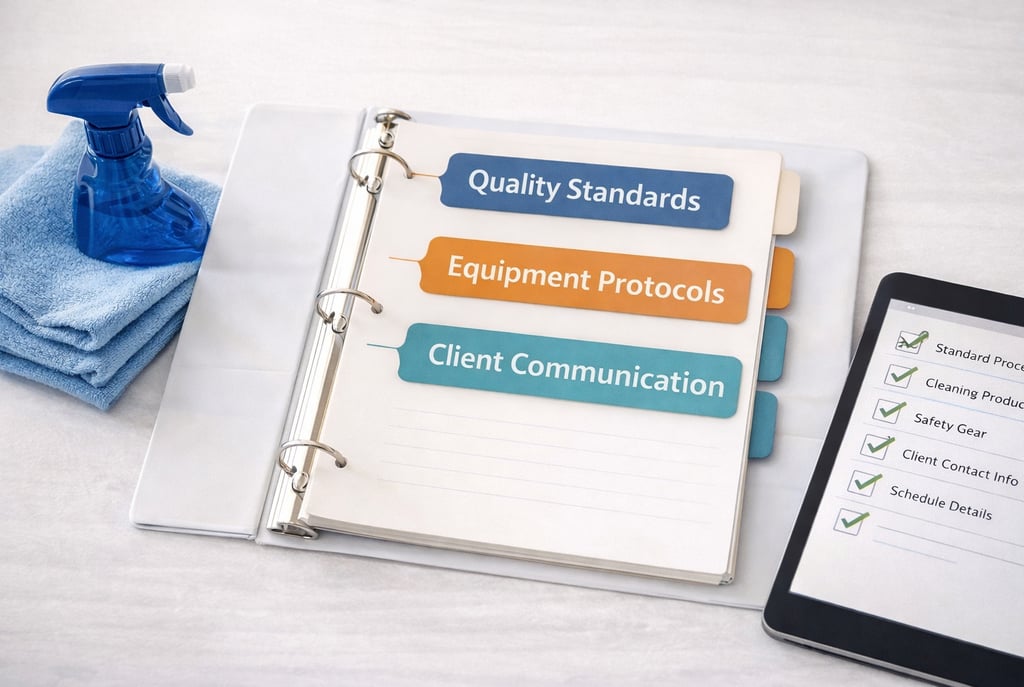
Format matters too. I use a three-ring binder with tab dividers—old school, but it works. Each section can be updated independently. We also have a digital version in Google Docs that team members can access from their phones.
Quick win: Start by documenting just one service you provide, start to finish. That's your template for the rest.
What Separates Professional Operations from Amateur Hour
After seven years, here's what I've noticed separates businesses that scale from those that struggle:
Professionals document the exceptions. Anyone can write "clean the office." But what do you do when the client leaves dirty dishes in the sink? When you find drug paraphernalia in a restroom? When equipment breaks mid-job? Those edge cases need procedures too.
They make it visual. We have a photo library showing proper technique, properly stocked supply carts, and completed work. New team members can see exactly what we expect.
They build in accountability. Our manual includes quality checklists that get initialed and dated. If there's ever a question about whether something was done, we have documentation.
They update regularly. Every quarter, Michelle and I review one section of the manual. Has anything changed? Did we learn a better way? Document it.
As a second-act entrepreneur, I appreciate systems that make life easier, not harder. The goal isn't to create bureaucracy—it's to create freedom. When processes are documented, you're not the only person who can solve problems.
If you want the actual operations templates I use in my business—including checklists, SOPs, and quality control forms—they're available in my Complete Systems Bundle. It's everything Michelle and I use, ready to customize for your business.
Your Next Steps
Building a cleaning business operations manual isn't glamorous work, but it's the foundation of everything else you want to accomplish. Want to take a vacation without constant phone calls? Need to hire your first employee? Hoping to build something you could eventually sell? You need documented systems.
Start this week. Pick one procedure that you explain repeatedly and write it down. Then another. Before you know it, you'll have a manual that transforms how your business operates.
Remember: I started documenting our systems three years into the business. You don't need seven years of experience first. You just need to start capturing what you know right now.
📋 Ready to Get Started?
Download my free Complete Commercial Cleaning Business Startup Guide with everything you need to launch and systemize your cleaning business. No hype, no fluff—just practical steps from someone who started at 51 and built a real business.
© 2026 Second Act Systems. All rights reserved.