Everything You Need to Launch Your Second Act Business. Nothing You Don't.
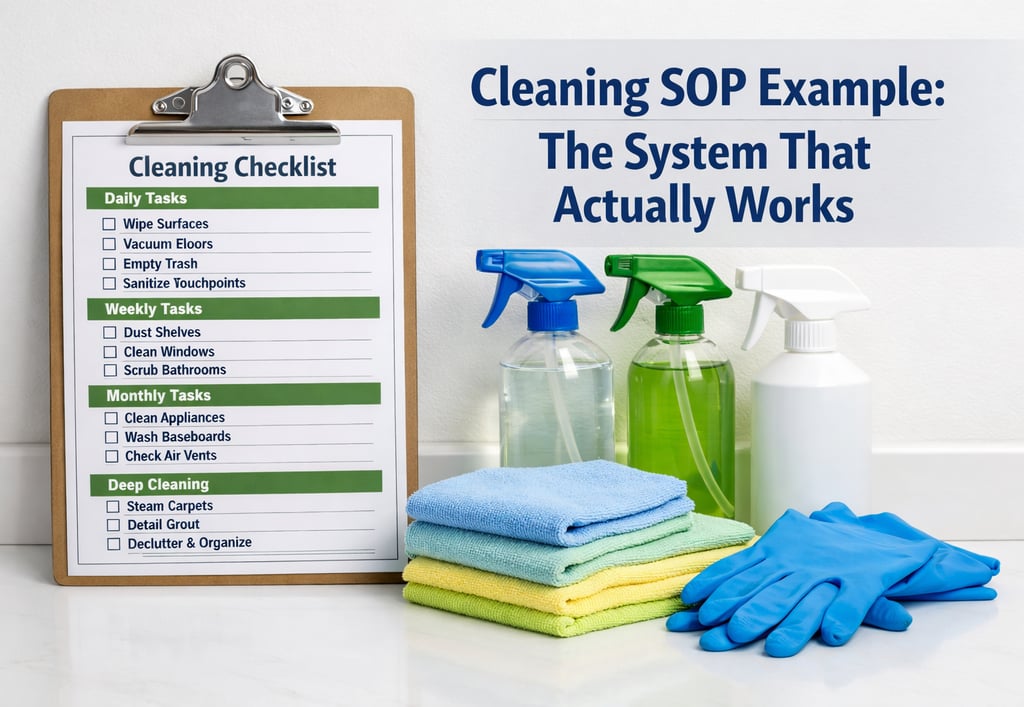
Cleaning SOP Example: The Step-by-Step System That Keeps Our Business Running Smoothly
A practical breakdown of how to create and implement cleaning business SOPs that actually get used, with real examples from 7 years of running a successful operation.
STARTING/MARKETING
2/9/20266 min read
You Can't Scale What You Can't Systematize
When Michelle and I started our cleaning business at 51, I thought SOPs were corporate bureaucracy—unnecessary paperwork that would slow us down. Then we landed our third client, and I showed up with the wrong supplies. Our fourth client complained about inconsistent bathroom cleaning. By client number seven, I couldn't remember who wanted eco-friendly products and who specifically requested bleach for their kitchen.
That's when I realized I needed a cleaning SOP example to follow—a real one, not some generic template that looked good on paper but failed in the field.
After seven years of refining our systems, I can tell you that solid SOPs are the difference between running a business and being owned by one. They're what allowed us to maintain quality even when I couldn't be on every job. They're what kept us from losing that $2,400/month contract we eventually lost (more on that later—and yes, even good systems can't prevent every loss).
In this post, I'll show you exactly what a working cleaning SOP looks like, using real examples from our business.
Why Most Cleaning Businesses Fail at Standard Operating Procedures
Here's the problem: most cleaning business owners either have no SOPs at all, or they've got a binder full of procedures nobody actually follows.
Common mistakes I see:
Creating SOPs that are too detailed (12 pages on how to clean a toilet? Really?)
Writing procedures so vague they're useless ("Clean thoroughly" tells you nothing)
Never updating SOPs after the initial creation
Storing them somewhere nobody can access when they need them
I made the third mistake myself. We created our bathroom cleaning SOP in year two, and I didn't update it for almost three years. Meanwhile, we'd switched products, changed our process, and adopted new tools. The SOP was worthless because it didn't reflect reality.
What happens when you get SOPs wrong? Your team members do things differently every time. Quality becomes inconsistent. You can't train new people efficiently. Clients notice the inconsistency and start shopping around.
That $2,400/month contract I mentioned? We didn't lose it because of bad work. We lost it because the facility manager changed, and the new manager wanted a different vendor. But you know what? Our SOPs kept us professional right up to the last day, and that client gave us a reference that landed us two smaller accounts.
What a Real Cleaning SOP Actually Looks Like
Let me show you our bathroom cleaning SOP—the actual one we use, stripped down to what matters.
The Basic Structure Every SOP Needs
Every SOP in our business follows the same format:
1. Purpose Statement (one sentence explaining why this procedure exists)
2. Scope (which jobs or situations this applies to)
3. Required Supplies (specific products and tools)
4. Step-by-Step Procedure (the actual process)
5. Quality Checkpoints (how to verify it's done right)
6. Time Estimate (how long it should take)
Pro tip: Keep the entire SOP to one page. If it's longer, you'll never reference it in the field.
Bathroom Cleaning SOP: A Real Example
Purpose: Ensure consistent, thorough bathroom cleaning that meets our quality standards and client expectations.
Scope: Applies to all standard residential bathroom cleaning (modify for commercial or medical office bathrooms).
Required Supplies:
All-purpose cleaner (Method or client-specified brand)
Glass cleaner
Toilet bowl cleaner
Microfiber cloths (3 minimum: one for toilet, one for general surfaces, one for glass)
Scrub brush
Vacuum with attachment
Mop and bucket
Step-by-Step Procedure:
Clear and prep (1 min)
Remove items from counters, tub edge
Place bath mats outside room
Open window or turn on fan
Start toilet (30 seconds)
Apply bowl cleaner, let sit while cleaning other areas
This is your timer—never skip this step
High to low dusting (2 min)
Ceiling fan/light fixtures
Window sills
Countertop surfaces
Cabinet fronts
Mirrors and glass (2 min)
Spray glass cleaner
Wipe with dedicated glass cloth
Check for streaks at angle
Counter and sink (3 min)
Spray all-purpose cleaner
Wipe entire counter
Clean faucet and handles
Scrub sink basin
Dry fixtures
Toilet (4 min)
Scrub bowl (the cleaner has been sitting)
Flush
Wipe exterior top to bottom: tank, handle, seat (both sides), base
Use dedicated toilet cloth—never use this cloth elsewhere
Many times I just use paper towels if it is excessively dirty
Tub/shower (5 min)
Spray walls and fixtures
Let sit 30 seconds
Scrub from top to bottom
Rinse thoroughly
Dry fixtures to prevent water spots
Floor (3 min)
Vacuum or sweep thoroughly (corners first)
Mop entire floor
Replace bath mats
Quality Checkpoints: □ No visible dust on any surface
□ Mirror streak-free
□ No cleaner residue in tub/shower
□ Toilet bowl clean, exterior wiped completely
□ Floor corners clean
□ All items returned to original position
Time Estimate: 20 minutes for standard bathroom
What Makes This SOP Work
Notice what's NOT in there:
No corporate jargon
No unnecessary detail about obvious things
No complicated charts or diagrams
No vague language like "clean well" or "ensure quality"
Notice what IS in there:
Specific products (or note to use client-specified)
Exact number of cloths needed and their dedicated purposes
The reason for certain steps ("This is your timer")
Time estimates so you can schedule accurately
💡 Free Resource: Grab my Cleaning Business Startup Checklist to get SOP templates and the complete framework I wish I'd had when I started at 51. No fluff—just the essentials that actually work.
How to Implement SOPs in Your Cleaning Business
Creating the SOP is step one. Making sure it gets used is step two.
Week 1: Write your first SOP for your most common cleaning task. Use our format above. Keep it to one page. Test it yourself on a real job.
Week 2: Have your team member (or future team member, if you're solo now) use it on a job while you observe. Note where they get confused or deviate from the process.
Week 3: Revise based on real-world use. Laminate it or put it in a protective sleeve. Keep a copy in your cleaning caddy.
Week 4: Create your second SOP using the same process.
The key is to start small. I see too many second-act entrepreneurs—people like us who are building something meaningful after 45—try to systematize everything at once. They burn out and abandon the whole thing.
Start with three SOPs:
Your most common cleaning task (bathroom, kitchen, etc.)
Your client onboarding process
Your quality control checklist
Those three will give you 80% of the benefit. Build from there.
Quick win for today: Before your next job, write down every step you take to clean one room. That's your rough draft SOP. Refine it later.
Advanced SOP Tips from 7 Years in the Trenches
Mistake to avoid: Creating different SOPs for every slight variation. We used to have separate bathroom SOPs for "small powder room," "standard bathroom," and "master bathroom." Ridiculous. Now we have one bathroom SOP with notes for adjusting time estimates based on size.
Pro tip for second-act entrepreneurs: If you're building this business to eventually step back (like Michelle and I are working toward location independence so we can escape Michigan winters), your SOPs need to be detailed enough that someone else can run the business without you. Test this by having someone follow your SOP without any verbal instruction from you.
What separates beginners from professionals: Professionals update their SOPs. Every quarter, I review our most-used SOPs and ask: "Is this still how we actually do it?" If not, update it. If the SOP says one thing but we're doing it differently, we either fix our process or fix the document.
The photo trick: For complex tasks, we take photos of the "finished" state. Our commercial kitchen SOP has a photo showing how the stainless steel should look when properly polished. Visual reference eliminates 90% of quality disputes.
If you want the complete SOP templates I use in my business—bathroom, kitchen, office, quality control, and more—they're all included in my Complete Bundle. These are the actual working documents Michelle and I refined over seven years, not generic templates that sound good but fail in practice.
Systems Aren't Sexy, But They Work
Look, writing SOPs isn't the exciting part of running a cleaning business. Landing a new client is exciting. Getting a great review is exciting. Systematizing bathroom cleaning procedures? Not exciting.
But here's what I've learned after seven years: the businesses that survive aren't the ones with the best marketing or the flashiest websites. They're the ones with solid systems that deliver consistent results.
Your cleaning SOP example doesn't have to be perfect on day one. Ours certainly wasn't. It just has to be real, practical, and used consistently.
Start with one SOP this week. Use the format I showed you. Test it on a real job. Refine it based on what happens in the field.
That's how you build a business that runs without you—eventually.
📋 Ready to Get Started?
Download my free Cleaning Business Startup Checklist with SOP templates, pricing calculators, client scripts, and everything you need to launch your cleaning business. No hype, no fluff—just practical systems from someone who started at 51 and is still running strong seven years later.
© 2026 Second Act Systems. All rights reserved.