Everything You Need to Launch Your Second Act Business. Nothing You Don't.
Cleaning Business Startup Costs: What You Actually Need to Spend
A practical breakdown of what it really costs to start a cleaning business — from registration and insurance to equipment and marketing — based on seven years of running our own operation.
STARTING/MARKETING
5/26/20265 min read
One of the first questions everyone asks before starting a cleaning business is: how much is this going to cost me?
And if you spend any time searching online, you'll find answers all over the map. Some articles will tell you that you can start for under $100. Others suggest you need $10,000 or more before you clean your first toilet. Neither of those numbers tells the full story.
When Michelle and I started our cleaning business, we didn't dump a pile of money into it on day one. We started lean, spent where it mattered, and added things as we grew. Seven years later, I can look back and tell you exactly what was worth the money early on — and what could have waited.
So let's break down the real cleaning business startup costs — not the fantasy version, and not the scare-you-out-of-it version. Just the practical, honest numbers based on what it actually takes to get started and start landing clients.
The "Start for Almost Nothing" Myth
Let's address this one first, because it comes up constantly.
Can you technically start a cleaning business with a bucket, some spray bottles, and a mop from the dollar store? Sure. People have done it. But there's a difference between starting a cleaning side hustle and starting a cleaning business — and that difference shows up fast.
Clients notice cheap equipment. They notice when your vacuum sounds like it's dying. They notice when your microfiber cloths are pilling and your spray bottles are leaking. And more importantly, you'll notice — because cheap tools make every job take longer, produce worse results, and burn you out faster than you'd expect.
You don't need to buy top-of-the-line everything, but you do need to invest in equipment that actually works and holds up. That's the floor.
The Real Startup Cost Categories
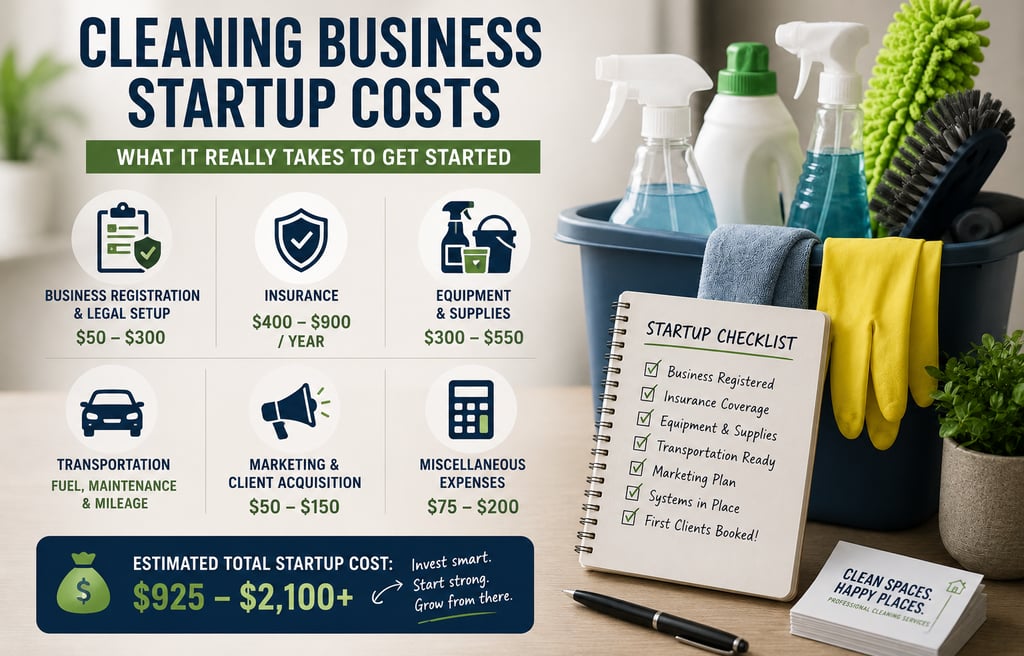
Here's how the expenses break down when you're being realistic about what you need before taking on your first client.
Business Registration and Legal Setup
This is the non-negotiable starting point. Depending on your state, you're looking at filing for an LLC or DBA, which typically runs between $50 and $300. Some states are on the cheaper end — Michigan, where we're based, falls in the middle. Others like California charge more.
You may also need a local business license depending on your city or county. These are usually under $100 but vary widely, so check your local requirements before assuming you're good to go.
Pro tip: Don't skip the LLC. I know it's tempting to just start cleaning under your own name, but an LLC separates your personal assets from your business. It's one of the cheapest forms of protection you can get, and it makes your business look legitimate from the start.
Insurance
General liability insurance is not optional if you're serious about this. You're working inside other people's homes and businesses. One broken item, one slip on a wet floor, one accusation that something went missing — and without insurance, you're personally on the hook for all of it.
General liability for a cleaning business typically runs between $30 and $75 per month, depending on your coverage level and your state. That's roughly $400 to $900 for your first year. If you're hiring employees, you'll also need workers' compensation insurance, which adds to the cost — but that's a future expense for most people starting solo or with a partner.
Don't let anyone convince you that insurance is something you can "add later." This is a day-one expense.
Equipment and Supplies
This is where people either overspend or underspend, and both create problems.
Here's what a reasonable starter equipment kit looks like: a quality commercial vacuum ($150–$300), a mop system that actually works ($40–$80), microfiber cloths in multiple colors for different surfaces ($25–$50), a reliable set of spray bottles ($15–$20), a caddy or tote to carry everything ($20–$30), and your core cleaning chemicals — a good all-purpose cleaner, glass cleaner, disinfectant, and a bathroom-specific product ($40–$60 to stock up initially).
All in, you're looking at somewhere between $300 and $550 for a solid starter kit that won't embarrass you on the job and won't fall apart after two weeks.
Pro tip: Invest in the vacuum. It's the single piece of equipment you'll use on every job, and the difference between a $75 big-box vacuum and a $200 commercial upright is night and day. We learned that one the expensive way — replacing cheap vacuums every few months ends up costing more than buying the right one from the start.
Transportation
Most people already have a vehicle, so this isn't always a true startup cost — but it's worth acknowledging. You'll be driving to jobs, hauling equipment, and putting miles on your car. If your current vehicle works, budget for the extra fuel and mileage. We started with our personal vehicles and upgraded when the business could pay for it.
Marketing and Client Acquisition
You need clients, and clients need to be able to find you. At minimum, that means a Google Business Profile (free), basic business cards ($25–$50 for a starter batch), and either a simple website or a social media presence — or both.
A basic website through a platform like Hostinger or Wix runs $3 to $10 per month. You don't need a fancy site — you need a clean page that explains your services, your service area, and how to contact you.
We built our client base through referrals, direct outreach, and showing up consistently. Paid advertising can come later when you have cash flow to support it.
Budget $50 to $150 for your initial marketing setup.
Miscellaneous Startup Expenses
There are always a few odds and ends that don't fit neatly into a category: branded shirts or aprons ($30–$60), a basic accounting app like Wave or QuickBooks ($0–$25/month), a scheduling tool or CRM, client intake forms and contracts, and a separate business bank account (usually free with most banks).
These smaller expenses add up to another $75 to $150 depending on what you prioritize.
So What's the Real Total?
Let's add it up. For a solo operator or a two-person team starting a cleaning business with proper registration, insurance, decent equipment, and basic marketing, you're realistically looking at:
Business registration: $50–$300
Insurance (first year): $400–$900
Equipment and supplies: $300–$550
Marketing: $50–$150
Miscellaneous: $75–$150
Realistic total: $875 to $2,050
That's the honest range. You can come in on the lower end if your state has cheap registration and you're disciplined about only buying what you need. You'll hit the higher end if you're in a pricier state, opt for better equipment upfront, or invest more in your marketing presence.
Either way, it's a fraction of what most businesses cost to launch — which is exactly why cleaning is one of the most accessible businesses out there.
Where People Waste Money Early On
I've seen people drop serious money on things that don't matter in the first 90 days: expensive logo design packages, premium website themes they don't know how to use, fancy uniforms before they have a single client, or a van wrap on a vehicle they're still making payments on.
None of that generates revenue. Spend your early dollars on the things that get you in the door — reliable equipment, proper insurance, and a professional presentation. The rest can scale with the business.
The Bottom Line
Starting a cleaning business doesn't require a massive investment, but it does require a smart one. The people who try to start for free usually end up spending more in the long run replacing cheap equipment and dealing with problems that proper setup would have prevented. And the people who overspend before their first client often create unnecessary financial pressure that makes the early months harder than they need to be.
Find the middle ground. Invest in the essentials. Start clean and professional. Then let the business fund its own growth.
Want a clear roadmap for getting your cleaning business off the ground? Check out our free Cleaning Business Startup Checklist at SecondActSystems.com — it walks you through every step so nothing falls through the cracks.
If you want the actual templates, contracts, and systems we use in our business, they're available in the Essential Templates Pack — built from seven years of running our own operation.
© 2026 Second Act Systems. All rights reserved.